
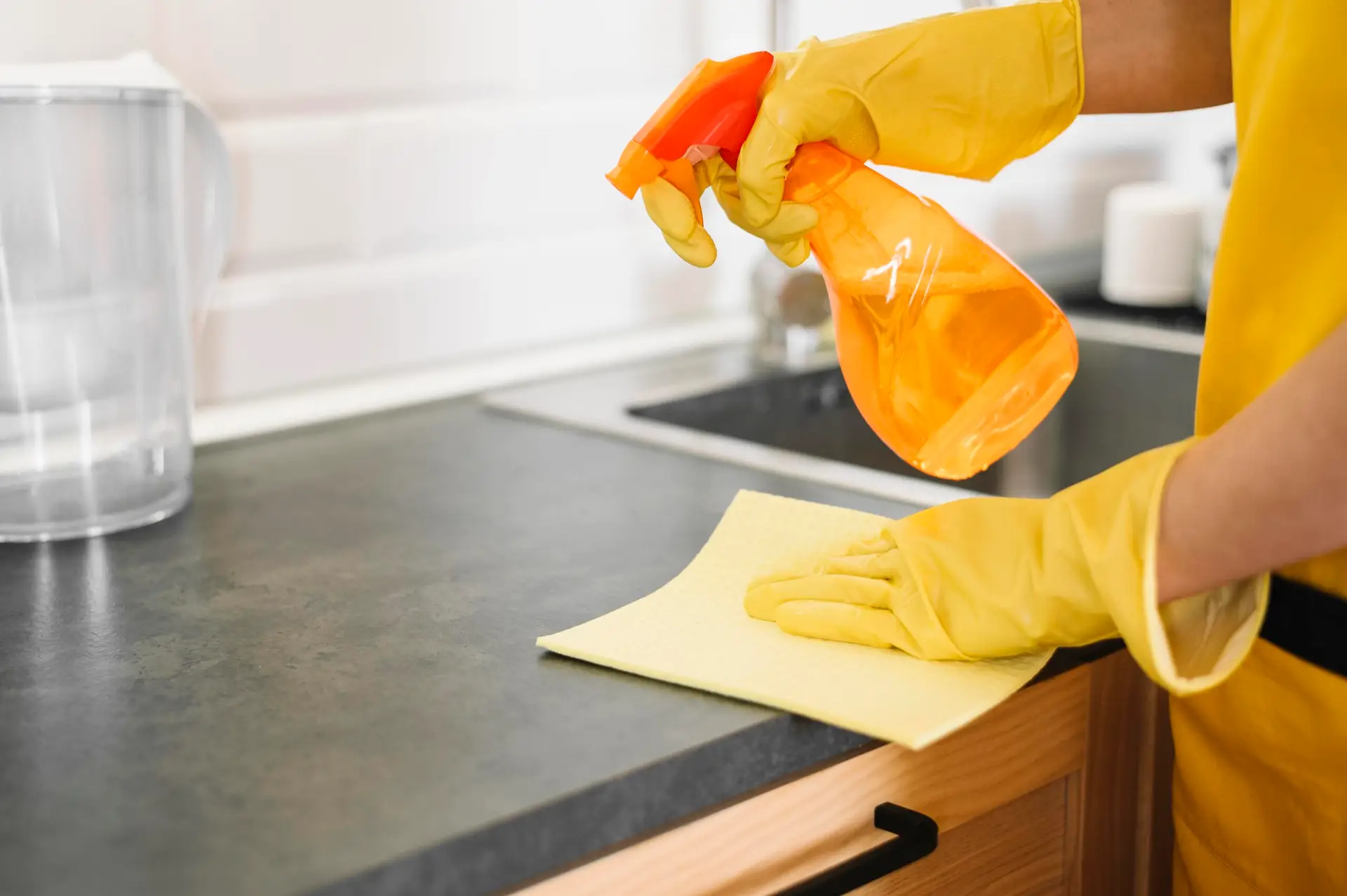
Your kitchen countertops are the workhorses of your home, exposed to food preparation, spills, heat, and chemicals. Using the wrong cleaner can lead to irreversible damage, resulting in dull, etched, or stained surfaces that compromise both appearance and hygiene. To maintain the beauty and integrity of your investment, it’s essential to match the cleaner’s composition (especially its pH level) to the specific material of your countertop.
Why Choosing the Right Cleaner Matters
The chemical structure of cleaning agents interacts very differently with various countertop materials, from natural stone to synthetic laminates.
Avoiding Stains and Surface Etching
The biggest risk in choosing an improper cleaner is damage caused by extreme pH levels.
- Etching: This is caused by highly acidic cleaners (low pH, such as vinegar or lemon juice) reacting with the calcium carbonate ($\text{CaCO}_{3}$) present in natural stone like granite, marble, and quartzite. The acid physically dissolves a microscopic layer of the surface, leaving behind a dull, noticeable water spot or ring that cannot be buffed out.
- Staining: Highly alkaline or caustic cleaners (high pH, such as ammonia-based products) can strip away protective sealants on porous stone surfaces. Once the sealant is gone, the stone is vulnerable to absorbing colored liquids (like wine or oil), leading to deep, difficult-to-remove stains.
- Delamination: For laminate countertops, harsh chemicals can degrade the adhesive holding the layers together, causing the top decorative layer to peel or buckle, known as delamination.
Safe Disinfection for Food Prep Areas
The kitchen counter is a crucial food preparation surface, meaning disinfection is vital, but safety is paramount. Many industrial disinfectants are safe for surfaces but leave behind residue that is toxic if it comes into contact with food.
A food-safe disinfectant must kill common kitchen pathogens like E. coli and Salmonella, but also dissipate quickly or break down into inert, non-toxic components, such as water and oxygen (like hydrogen peroxide, $\text{H}_{2}\text{O}_{2}$). Always ensure that any disinfectant is thoroughly rinsed or wiped away after the necessary dwell time.
Best Cleaners by Surface Type
Different materials require different care protocols to ensure longevity and shine.
Granite and Quartz – $\text{pH}$-Neutral Sprays
Both granite (a natural stone) and quartz (an engineered stone) require cleaning solutions with a neutral $\text{pH}$ (around $7$).
- Granite: Granite is porous and typically requires a sealant. Strong acids (vinegar, lemon, or any toilet cleaner) will destroy the sealant and eventually etch the stone. Strong alkaline products (ammonia, oven cleaner) will strip the sealant instantly. Best Cleaner: Specialized stone cleaner or a small amount of mild, $\text{pH}$-neutral dish soap diluted in water.
- Quartz: While non-porous and more resistant to stains than granite, quartz is engineered using resin binders that can be damaged by solvents, abrasive cleaners, or high heat. Best Cleaner: Use dedicated quartz cleaner or the same $\text{pH}$-neutral mild soap and water solution recommended for granite.
Laminate – Mild Soap and Warm Water
Laminate countertops (often branded as Formica or Wilsonart) are budget-friendly and durable, but their edges and seams are vulnerable to moisture.
- Avoid Abrasives: Do not use scouring pads or highly abrasive cleaners, as they can scratch the plastic-based surface and dull the finish.
- Avoid Excess Water: Never let standing water pool on seams or near the backsplash, as this can cause the wood substrate underneath to swell and the laminate to separate.
- Best Cleaner: Mild liquid dish soap (the kind used for handwashing dishes) mixed with warm water, applied with a soft cloth. Dry the counter immediately afterward.
Stainless Steel – Vinegar and Microfiber Cloth
Stainless steel sinks and certain stainless countertop sections are prone to streaks, fingerprints, and water spots, but they are highly resistant to chemical damage.
- Fingerprints and Water Spots: These are easily cut through by the mild acetic acid in vinegar.
- Best Cleaner: Create a $1:1$ solution of white vinegar and water. Spray the surface, and wipe down immediately using a microfiber cloth.
- Key Technique: Always wipe in the direction of the metal’s grain. Wiping against the grain will create micro-scratches that collect grime and dull the finish over time. Follow up with a tiny drop of mineral oil or olive oil rubbed into the grain to boost shine and repel future fingerprints.
DIY Kitchen Surface Cleaning Recipes
If you prefer to avoid harsh chemicals, the most effective cleaners are often found right in your pantry.
Vinegar and Water for Daily Cleaning
This mixture is highly effective for cleaning glass, laminate, stainless steel, and sealed tile, acting as a natural, mild disinfectant and deodorizer.
- Ratio: Mix $\text{1 part}$ distilled white vinegar with $\text{3 parts}$ water.
- Use: Use this spray for daily wipe-downs to break down soap scum and grease film.
- Caution: Do not use this solution on natural stone (granite, marble, quartzite) or cast iron. The acetic acid will etch the stone and can cause cast iron to rust.
Baking Soda Paste for Tough Grease
Baking soda ($\text{NaHCO}_{3}$) is an invaluable, non-toxic, and gentle abrasive safe for almost every surface except unsealed porous stone or fine acrylic finishes.
- Preparation: Mix baking soda with a small amount of water or dish soap to create a thick, spreadable paste.
- Application: Apply the paste directly to tough, caked-on grease stains or sticky spots on stovetops, sinks, or laminate counters.
- Scrubbing: Allow the paste to sit for $\text{10 minutes}$, then scrub gently with a soft sponge. The fine particles of baking soda will lift the grime without scratching the surface.
Tips for a Germ-Free Kitchen
Cleaning removes visible dirt, but sanitizing is the act of killing germs. Both are necessary for a hygienic kitchen.
Disinfect High-Touch Areas Like Handles and Switches
Germs spread rapidly via shared contact points. Disinfecting the counters is not enough; you must target the areas hands touch most frequently.
- Target List: Refrigerator and freezer handles, oven and microwave door handles, sink faucet handles, light switches, drawer pulls, and trash can lids.
- Method: Use an alcohol-based wipe or a disinfectant spray with the correct dwell time (the amount of time the product must remain wet on the surface to kill germs).
Avoid Cross-Contamination with Separate Sponges
The kitchen sponge is often the dirtiest item in the house. Using the same sponge for raw chicken prep and then wiping down the countertop is a major source of cross-contamination.
- Color-Coding: Implement a simple system, such as using a yellow cloth for general wiping and a red cloth or disposable paper towel solely for cleaning up after raw meat.
- Sponge Sanitization: At the end of the day, dampen your general-purpose sponge and microwave it on high for $\text{90 seconds}$ to kill $\text{99.9\%}$ of bacteria. Replace sponges weekly.
FAQs
Can I use bleach on kitchen surfaces?
Yes, but with major qualifications. Bleach (Sodium Hypochlorite, $\text{NaClO}$) is a powerful and effective disinfectant when properly diluted.
- Dilution is Key: A standard disinfecting solution is $\text{1 part}$ bleach to $\text{10 parts}$ water.
- Surface Warnings: Never use full-strength bleach. Avoid using bleach on stainless steel, as it can cause pitting and oxidation (rust). Avoid using bleach on granite, as it will strip the sealant and can cause discoloration.
- Ventilation: Bleach emits fumes. Always ensure the kitchen is well-ventilated when using it.
What’s the safest natural cleaner for food areas?
For a $\text{100\%}$ food-safe option that is highly effective at sanitizing, look toward food-grade hydrogen peroxide ($\text{H}_{2}\text{O}_{2}$).
The $\text{3\%}$ solution commonly sold in drugstores is a powerful disinfectant that breaks down into just water and oxygen after it kills germs. It leaves no toxic residue and is safe for use on most countertop types (including stone, provided you don’t allow it to sit for extended periods). Simply spray the $\text{3\%}$ solution, let it sit for $\text{5 minutes}$, and wipe clean.
Don’t let cleaning confusion compromise the health and beauty of your kitchen. Countertops are a substantial investment—let us handle their specialized care.
Contact Tammy’s Crew Cleaning today for customized, damage-free, and hygienically clean results in every area of your home!